

Bertrand Boisseau
5 December 2025
From cloud to dashboard: experience the future of infotainment development at CES 2026
Every year at CES, we try to go beyond showing technology; we want to give you an experience. This time, it’s the story of how in-vehicle infotainment development is transforming, and how developers can now build, test, and deploy immersive experiences faster than ever.
This year, we’re excited to show a demo that combines the strengths of both Anbox Cloud and Rightware’s Kanzi, the industry-leading software for creating rich, visually stunning infotainment interfaces. It demonstrates cloud-native development, automation, and how virtualization can open up completely new ways to design and test next-generation in-vehicle experiences.
Bridging design, development, and validation
Automotive software development has become incredibly complex. Teams are often focused on their own discipline, UI designers on immersive experiences, Android developers on building integrations, and validation engineers on reliability across hardware variants. These teams can’t always collaborate seamlessly.
Testing an infotainment system means being able to access specific hardware or prototypes, which makes iteration slow and collaboration difficult. Small design updates can take days to validate, and testing across different screen configurations or performance conditions is often limited by the availability of physical setups.
We wanted to change that by bringing agility and scalability to infotainment development.
Infotainment comes to life in the cloud
In our demo, we’ll show how Anbox Cloud turns this traditionally hardware-bound process into a fully virtualized, cloud-native experience. By running Android in the cloud, developers can instantly deploy and test infotainment environments built using Kanzi, on demand, at any scale, from anywhere.
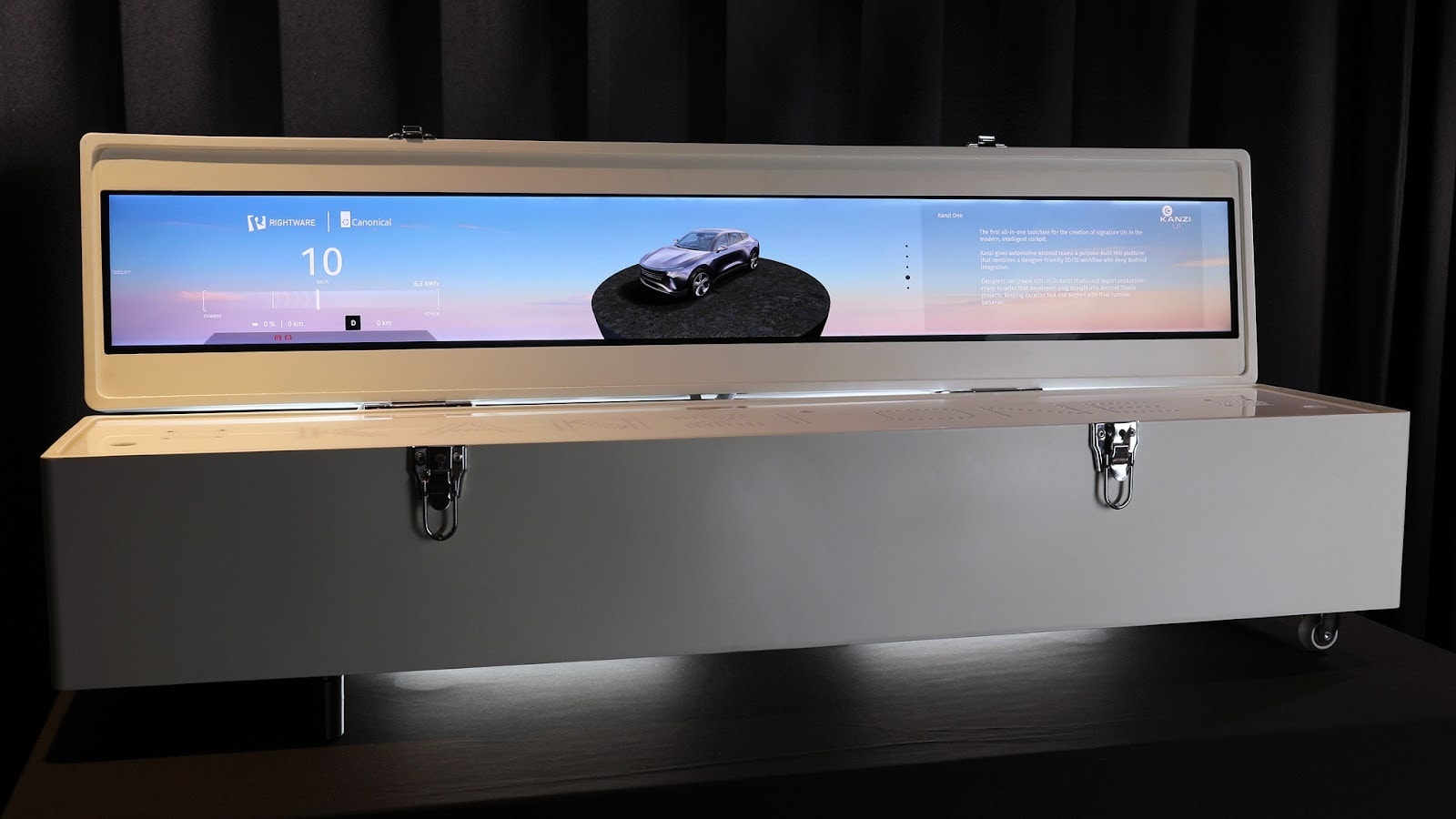
Widescreen 8K infotainment CES demo
Our setup fits perfectly with Rightware’s widescreen 8K infotainment and cluster bench, powered by Kanzi. Developers can stream the exact same 8K rendering using Anbox Cloud. The result is an impressive, interactive experience, generated and streamed entirely from the cloud.

8K virtual Android device running on Anbox Cloud
Thanks to Anbox Cloud, Android can be virtualized to any resolution, with pixel-perfect rendering and responsiveness. It can scale to dozens of Android instances running simultaneously, so teams can run automated testing, validate UI performance, and work on the system updates in parallel. Your development becomes faster, collaborative, and independent of physical limitations.
Why choose cloud-native Android development?
When moving your development testing to the cloud, designers and developers can collaborate in real time and can see their changes without waiting for hardware to be available. Validation teams can run automated tests on multiple Android instances, across different configurations. For OEMs and Tier 1 suppliers, this means shorter development cycles, meaning more efficient resource use, and faster results.
“Kanzi has always been about empowering designers and developers to bring exceptional in-vehicle experiences to life,” says Tero Koivu, Co-CEO at Rightware. “Seeing a Kanzi made UI streamed at 8K through Anbox Cloud shows how cloud-native workflows can dramatically accelerate iteration and collaboration. It opens a powerful new path for teams building the next generation of connected, visually stunning automotive user interfaces.”
See it at CES 2026
Join us at LVCC, North Hall, Booth #10562, and check out the workflow for yourself. You’ll see how Kanzi and Anbox Cloud come together to deliver high-fidelity, scalable, cloud-native infotainment experiences, and how this is redefining the way developers can use Android in the cloud.
Come see the future of automotive software development, from cloud to dashboard.
In the meantime, learn more about Anbox Cloud, and Rightware.
Further reading
Official documentation
Anbox Cloud Appliance
Learn more about Anbox Cloud
Android is a trademark of Google LLC. Anbox Cloud uses assets available through the Android Open Source Project.


